Showing posts with label Beginners guide book. Show all posts

Friday, 6 November 2015

Supremely awesome chair yoga


Seated yoga is brilliant if you don't have time to get your mat our or if you're tight while travelling or at work. Take a few minutes to work through these basic seated yoga postures to feel refreshed and ready to kick some ass! Always be careful, especially if you have an injury or any medical condition, be patient with your body and let your breath flow deeply and effortlessly to ease the mind along with the body. Have fun! 

Sanskrit names
  • Surya Namaskar (Sun Salute) 
  • Eka Pada Rajakapotasana (Pigeon pose)
Benefits
  • Increased body flow around the body
  • Better lymph drainage, especially in the legs
  • More efficient synovial fluid in joints  
  • Decreases chance of headaches 
  • Reduces upper back, chest, neck, shoulder and hip tightness
Cautions
  • Make sure you use a full, deep belly breath as you move through these postures, but don't hyperventilate
  • Don't move into pain, always make sure you are comfortable but are challenging yourself 

Surya Namaskar


INHALE to lift up. Brilliant first thing in the morning.  
EXHALE and fold forwards 


  • Sit on a chair, legs at 90* and feet planted hip width. 
  • INHALE lift the arms over head, lift the chest and look up, stretch up as tall as you can.
  • EXHALE bring the hands down to the thighs and trace the hands down the legs until they touch your shins, toes or the floor. 
  • Let the belly tuck in deeply and drop the chin to the chest. 
  • INAHLE and reach the arms all the way back up, repeating the sequence.
  • Move with the breath and repeat anywhere from 3-10 times.

Eka Pada Rajakaptoasana

Seated Eka Pada Rajakaptoasana
Deepening the stretch.
A must when travelling on a plane. 

Knee hugs are always good after a big stretch!


  • Sit on a chair, legs at 90* and feet planted hip width. 
  • Take your right ankle on top of you leg knee. 
  • EXHALE and lift the chest as you start to gently fold forward over you legs. Only go as far as comfortable. 
  • Keep the spine as tall as you can as you breathe. 
  • Hold for as many breaths as comfortably, allowing yourself to sink deeper with each EXHALE
  • INAHLE and gently rise back up.
  • Hug the right knee into the chest to release the ankle and the knee, hold for a breath. 
  • Feel the release and openness of the hips and your lower spine.
  • Repeat on the left leg when ready.

Seated Twist
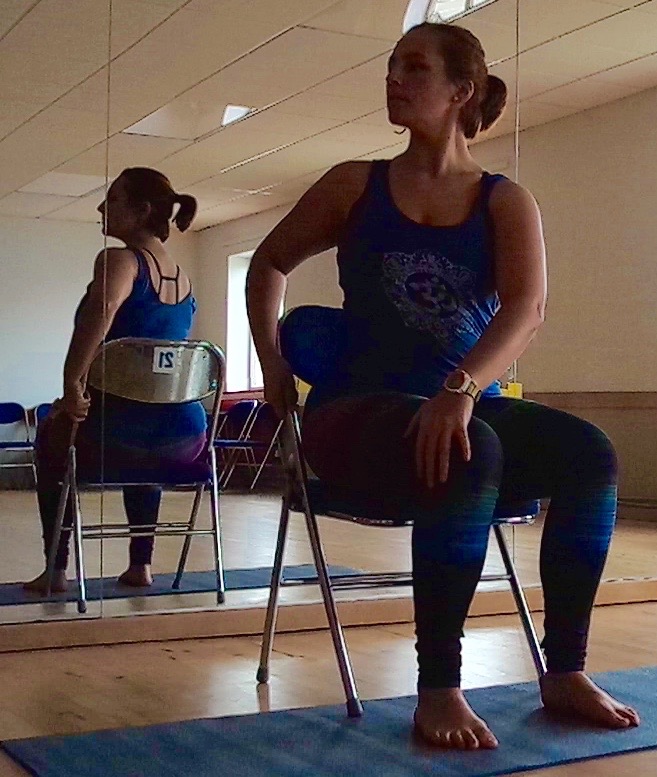
Seated twist.
Great for long hours at a computer or during a long journey. 


  • Sit on a chair, legs at 90* and feet planted hip width.
  • Belly tucked in gently to help lift the spine tall.
  • EXHALE twist to the left taking your right hand to the outside of your left knee and the left hand to a chair leg.
  • Breathe here.
  • Keep lifting the chest and pulling the shoulders back. 
  • Feel tall and majestic.
  • Hold for 3- 5 breaths.
  • INHALE and gently come back to your centre, repeating on the opposite side when you are ready. 
Neck stretches

Neck stretches. Perfect for tight shoulders and tension headaches.


  • Sit on a chair, legs at 90* and feet planted hip width.
  • Belly tucked in gently to help lift the spine tall.
  • INHALE take your right arm down by your side and reach your fingers towards the floor away from your hip. EXHALE and take your left ear to your left shoulder. Only go as far as comfortable.
  • Gently move the head to gaze down at your legs to stretch down the upper back/ shoulder and gaze up to the ceiling to release the front of the neck and upper chest. 
  • Hold for 3-5 breaths.
  • INHALE to bring the head back up and rest the right arm on your thigh. Repeat with the left arm. 
  • ALWAYS be gentle with your neck. Allow yourself to be at ease as you stretch, don’t move into pain. 

Tuesday, 6 January 2015

Setting an intention


Setting intentions is a great way to help kickstart a new yoga practice or help boost a well matured practice. With the new year now in full swing, intentions are a great way to help reach your resolutions! 

What's an intention?


  • An intention is a little goal that is set at the beginning of a yoga practice to achieve within the practice itself, throughout the day or to help you live mindfully. 
  • They're like little aims that help you achieve your overall goals. 
How does it work? 
  • At the beginning of your practice set your intention
  • Gently repeat it to yourself a few times before you fully begin 
  • Throughout your practice remind yourself and continue to repeat your intention a few times, especially if your mind wonders off or you get bored/ frustrated/ upset etc. 
  • During your pranayama practice is a great time to fully immerse yourself in your intention and let yourself be fully absorbed by it 
  • Using an active hasta mudra with your intention is a great way to really reinforce it into your practice 

Little, lovely snippets
  • Yogic intentions are designed to be small and manageable. 
  • They aren't big, brassy statements that might frighten you like, "I'm going to do the splits today!", on your second ever class. 
  • They are more like little reminders. "Today I will remember to breath fully with my diaphragm" (I actually just took a proper breath after typing that :P) or "I will great everyone with kindness" or "I will continue to work on improving my hip flexibility to reach the splits". 
  • Bite size. Memorable. Little goals. 
  • You can set a new intention at the beginning of every practice or maintain the same one. It's your practice and practice what makes your soul sing! 
  • Don't bog yourself down. If you don't achieve your intention, keep practicing. Practice. Practice. Practice. 
  • Enjoy your intentions! 


Have beautiful practice today! Nameste ॐ

Friday, 12 September 2014

What is a mudra?

A mudra a gesture. I used to think that mudras were just hand gestures but there are eye positions, body poses and breathing techniques which are also called mudras. However, I'm only explaining hand mudras, cause I really, really love hand mudras and I find them fascinating! 

Hands mudras are symbolic finger positionings that help to shift the thought processes in the mind and body and connect to a different level of consciousness. They do this by having certain aims and affects to different areas of the body and the mind. For examplé:

Chin Mudra 


The Chin hand Mudra 
The Chin Mudra is definitely the most famous hand gesture of them all. Ask someone to sit and look like they're meditating and they'll probably pull out a chin mudra! This hand position  brings clarity to the mind. The three extended fingers symbolise the traits of evolution: lethargy, activity, balance and harmony. The enclosed circle of the first finger and thumb indicate the goal of yoga- to unite your soul and the soul of the the world. Now isn't that really lovely? 

Mudras can become very gratifying when practiced regularly. Their powers start to show a little more each time you use them. Mudras can be practiced with visualisations and affrimations but I think as a beginner it's more beneficial to use them by themselves and only focus on the goodness in your hands. 

So, if you fancy trying the Chin Mudra out, find a comfy place to sit where you won't be disturbed and your feet can touch the ground (having the feet on the floor connects you to the  Earth and gets the yogic juices flowing.) Place the first fingers and thumbs together and straighten the other three outwards. Pop your palms facing downwards (having the palm upwards is a slightly different mudra) onto your thighs or knees and breath. Sit and breath in the peace and quiet and feel the power of your breath and how you are completely connected to the world. Don't be frightened if you start to feel silly or overwhelmed, breath for a few minutes and test it out. Give yourself time to adjust to mudras. Some people (including myself) are very susceptible to them. They all do different things so try a few out in a week and let yourself fall in love with them! 

Have fun, smile and breath! 

Wednesday, 10 September 2014

A few helpful definitions

Starting yoga is a really exciting experience. There are mounds of information to take in about postures, breathing techniques and ways of life, but you come across plenty of yoga jargon which can all sound similar, and ultimately, pretty confusing! Here's a quick breakdown of some words all beginners will hear.

Yoga

  • Yoga means union. It is the connection of the consciousness, physical body and all the energy in the universe to everything. Yes, everything. All beings, whether they been an animal, plant, inanimate object or ameoba. Connected through the energy surrounding us and within us. Joining  even the tiniest of molecules into the gigantic cosmos. 
Asana
  • Asana literally means seat. At the end of nearly all sanskrit posture names will been 'asana', to sit in the posture. However not every posture is a seated posture, it means to remain or to be present in the pose. Absorb it in all it's glory! For example, Garudasana is Eagle pose. Garud= Eagle and asana= seat, but Eagle is a standing balance pose. So, feel like a soaring eagle while enjoying the benefits and challenges of the pose in your seat. 
Pranayama
  • Pranayama means to extend prana. Prana is the life force, the energy which everything is made up of. Pranayama is a series of breathing techniques to control and deepen the breath to make it more efficient in the moving of prana around the body. For example, Ujjayi is called 'Warming breath' or 'Ocean breath'. You gently close the epiglottis (little flap that covers the wind pipe when you swallow) as you exhale to give the breath a slightly rough texture and produce a 'hhsssshhh' sound. It warms up the throat as you move the back of the throat backwards and forwards and allows for an easier passage for the breath to flow through during the rest of the yoga practice. 
Have you been put back by yoga sanskrit before and not been sure whats going on? Feel free to ask any questions and post any words you'd like explaining! A little blog feedback would be much appreciated :) 

Wednesday, 3 September 2014

What not to worry about when starting yoga

What not to worry about when starting yoga as a complete beginner and a little bit of help to get started.

'I'm not flexible enough...'
THE comment every yoga teacher has heard more than once! It's very easy to think that yoga is all about being flexible when the glossy picture in magazines show ladies bending backwards and touching their toes to the top of their head but alas, there is so much more to gain than flexibility! How about calming the mind or learning to meditate to achieve a bit more inner peace? Flexibility comes from dedication and persistence and unless you are lucky enough to be built like a piece of rubber achieving the most beautiful advanced poses takes a long time. So don't fret about not being able to straighten your legs completely when forward folding, just enjoy the stretch, breathe and smile :)

'I'm going to be really bad...'
Everyone has to be a beginner at some point to become an expert! And that's why we use blocks, blankets, straps, walls and chairs in yoga. Everyone needs help at some point, whether it be for balance or because of tight, restricting muscles, the props are there to aid and ease the practice (and most importantly to not let you injury yourself or get frustrated cause thats no fun.) Even if you do fall over or can't sit still while doing some pranayama, the most important thing is to smile, laugh and keep going. 

'I'm not spiritual...'
I can perfectly understand that some people feel uncomfortable during spiritual aspects of yoga which is why you should always do a bit of research before trying different types. Some styles are very spiritual and include a lot of meditating and working with energy within the body, such as kripalu and kundalini yoga whereas others focus more of the physical elements, such as triyoga or yin yoga. If you have any questions about the yoga you are interested in don't be afraid to ask the teacher. They'll be able to sort out any queries you have and give you some more insights into whether the style is right for you. There is a style of yoga for everyone so give a few ago and have fun with them!

'I don't have time...'

One of my all time favourite quotes is "If you have time for Facebook, you have time for yoga." Man, it gets me so motivated every time I read it! I want to slam my laptop shut and jump onto my mat like an excited puppy! It also helps to get my nose out of my technology and tune into my body which is vital for everyday happiness. So, next time you want to try some yoga but feel like you haven't got any spare time, get off the internet for an hour or put your phone away and have a stretch. If your time management means your schedule is packed out there is always a spare few minutes for some stretching in your desk chair or breathing in the car while waiting at traffic lights. Give it a go and let the endorphins flow and the smile grow!

So, being a beginner can feel a little daunting if you've never tried yoga but be brave and you could try a couple of videos on your own to try some different styles and ask any questions you have to your local yoga teacher. Before you know it, 20 minutes every other day could turn into an hour a day. Have fun, listen to your body and smile!